martes, 29 de septiembre de 2020

Visibility

I bought this book not because I am interested in the FBI, but because the guy selling it chose to emphasize the name of the translator (Rodolfo Walsh, a great Argentine writer, an activist), which had not been included on the front cover.

May translators and interpreters have the place they (we) deserve.

Aurora Humarán


sábado, 26 de septiembre de 2020

Weavers


Like Penelope, translators weave and unweave (words). Penelope is waiting for Odysseus. What are we waiting for?

Aurora Humarán

sábado, 19 de septiembre de 2020

I Confess that I Have Wept


He was christened Ricardo E. Neftalí Reyes Basoalto. But as soon as he discovered that he wanted to be a poet (something that happened when he was still quite small), he decided to change his name: Pablo, because it had a musical ring, and Neruda, in honor of the Czech poet, Jan Neruda.
This humble translator also felt a love for poetry from a very young age. Family legend (those stories one doesn't quite trust because they sound like an exaggeration, but with which one willingly plays along) claims that I learned to read on my own as a little girl of five when hepatitis forced me to stay in bed.
I recall how in first grade the teacher asked us to write a sentence describing the day: Today it is sunny. Today the sky is full of clouds. But that wasn't enough for me and I would write a page at least.
Then "they" came into my life, friends that gave without expecting anything in return, silent friends: books.
My first major books were these four volumes of the Diccionario Enciclopédico de Ramón Sopena that my Grandmother Blanca Aurora gave me when I entered second grade. I say "these" because they are right here by my side, even though Internet has made them feel a little old-fashioned in certain senses, in certain words.
One day I stood in front of my mother Leticia's bookcase and chose a book, "a grown-up book". What a thrill! I was seven and read El habitante y su esperanza by Pablo Neruda. There were a lot of things I didn't understand. How wouldn't there be? But I caught the magic anyway and it came to live in my heart forever.
Pablo Neruda is one of my favorite authors. His book Confieso que he vivido (I Confess that I have Lived) touched me. I once said that the title alone bears a devastating, suggestive and tremendous weight, like everything else that The Great Chilean wrote. There have been times that Neruda the prose writer has been the friend that accompanied me, while at others, it has been Neruda the poet, one of the most colossal poets I have ever read.
Not long ago I traveled to Chile. How could I not visit Isla Negra, the place about which I had read so much, a place that had fed my fantasy, that had enriched my life? As soon as I touched down in the Santiago Airport, off I went to Isla Negra in the company of a Chilean friend and colleague and my family (with all of our luggage still in the trunk of the car).
The Pacific...Ah, the Pacific! They can't fool me: In order to paint the Pacific, God has to have used a special shade of blue that he never used again in all the rest of Creation. It is to the color of the Pacific that we owe a debt of gratitude for part of Neruda's body of works.
I should note here that Isla Negra is the name of a small, adorable town. It is not an island.
Pablo Neruda's house is built on the edge of the sea. The author loved the sea, but at the same time feared it. The house imitates the shape of a ship: It is long and the doors are quite narrow. The ceilings are of wood and are vaulted. The entire place is full of marine objects. And beside the house, on terra firma, is a small wooden boat that remained there, forever immobile, on a decision by the author, just a few meters from its natural destination.
It took Neruda thirty years to finish his home, which houses a surprising number of collections — remember that Neruda traveled extensively — of all types and origins: bottles, masks, figureheads, chairs, miniature guitars, jugs, piano leg casters...
And I confess that I have wept...When we entered the room where the ships' figureheads are kept, I cried. I had been building up to this for a long time: I knew that being in the temple of Isla Negra was going to make me lose it. I had prepared for it long in advance. When I bought the tickets to fly to Chile? When I started playing with the crazy idea of a side-trip to Isla Negra? No. I had been building up to this since that day when I was seven years old and had the audacity and the good luck to delve into the literary world of this admirable Chilean.
Outside, Pablo Neruda's grave awaited me. Visitors aren't allowed to leave flowers or messages, but hey...who was going to see a tiny slip of miniscule paper (and the redundancy is intentional) that I nestled among the stones? With a sob of emotion, I bent close to him and left my message.
One word for Neruda, who had written so many thousands of times for me.
A single word. I said little to him. I said a lot to him.
I told him: "Thanks."

Aurora Humarán
P.S. for Neruda: You didn't sing in vain, Pablo.

viernes, 18 de septiembre de 2020

La fascinante historia de la lengua española (Alma Flor Ada / F. Isabel Campoy)


Un oasis

Divinísima la e-presentación del libro de Isabel Campoy y Alma Flor Ada, "LA FASCINANTE HISTORIA DE LA LENGUA ESPAÑOLA". Un chapuzón de felicidad en medio de este año loco. Isabel y Alma nos contaron la historia del español. Los invitados casi parecíamos niñitos y niñitas escuchando admirados y con atención sobre las idas y vueltas de los celtas, los godos, los árabes, los romanos... La mezcla que me gusta de rigor académico con muchísima simpatía. Muchas gracias por la invitación. ¡Los mejores augurios para el nuevo hijo!
Aurora Humarán pd: hoy aprendí que la palabra "petunia" viene del guaraní.

domingo, 23 de agosto de 2020

Obsesiones


El verdadero apellido de Mauro Z es Sztajnszrajber. Mauro es hermano de Darío quien sí usa el apellido completo. 

Como bien sabemos, el idioma sirve para hablar y también para pensar (Gracias, Chomsky). Sin embargo, como ocurre con este apellido, hay palabras sobre las que deslizamos nuestros ojos mientras en la cabeza armamos una especie de hilera loca, así: &_*- #-¿-fraslafra"¡=.($'#}>)/* 

Si tuviera que presentar a alguno de los hermanos en una conferencia, indudablemente averiguaría la forma correcta de pronunciar el apellido (y la practicaría, como siempre hago en las conferencias), pero cuando estoy "de entre casa", me conformo con los ruidos locos internos.

Me pasó lo mismo cuando leí Milenium, la necesaria trilogía del genio Stieg Larsson. Pasaba los ojos sobre los apellidos suecos, pero como quien hace snorkelling y no buceo. Confieso que al principio me costaba por la falta de costumbre, claro. Unas pocas páginas luego de comenzar el primer libro, pensé en abandonarlo (y qué suerte que no lo hice porque me habría privado de tres grandes obras). Pero así somos los traductores: quereremos entender todas las palabras, saber todo, pronunciar bien todo. Uno de los muchos TOC que tenemos.

Aurora Humarán


miércoles, 19 de agosto de 2020

Ancient times


"Translator" in Sumerian 


Source: Is That a Fish in Your Ear?: Translation and the Meaning of Everything (David Bellos)


Breakthrough technology from the eighties


martes, 11 de agosto de 2020

Puentes genéticos


❤ Traducir es bello.

❤ Traducir sobre niños y niñas que no tienen pelo rubio, sino pelo negro y enruladito... ¡y que son héroes y heroínas de la historia! es algo que te tranquiliza. El mundo se está acomodando como corresponde.

❤ Si para colmo de bienes te toca traducir con una gran palabrista que resulta ser tu hija, bueno, eso ya es lo más parecido a la felicidad absoluta.

¡GRACIAS!

Aurora Humarán


miércoles, 8 de julio de 2020

My experience translating "A long walk to water" by Linda Sue Park


A long walk to hope. A long walk to salvation.
(The experience of translating A long walk to water)

For Isabel Campoy, my fairy godmother

THE EXPERIENCE

The experience of translating is magical. And multifaceted. Sometimes (very seldom, actually) it’s simple; sometimes (that is, almost all the time), it’s terribly complicated. And this doesn’t necessarily entail that it’s a “difficult” text with hyper-technical vocabulary. Paradoxically, those are usually the easiest to translate. Technical terms usually remain the same. In other endeavors that might seem simpler, what eludes us are the subtleties the text calls for, or that we demand of ourselves. I need this word, not that one. The words dodge our grasp, or hide from us or refuse to come forward. Almost always at some point the heavens open, and Saint Jerome himself, with collegial complicity, slips us what we’ve been looking for. (There are also translator angels who whisper words to us as we sleep, and then what an epic awakening we have…).  

We crossers of bridges live between two languages (in my case, English and Spanish). Sometimes we end up stuck in a limbo that’s just a tad hallucinatory. But as history shows, we always emerge at the right moment, and nearly always with the necessary word.  

There’s one thing that any seasoned translator knows: every translation leaves you richer. Without fail. With more words, with the endowment derived from the work of translating about cities, contracts, syndromes, policies, the Dinka tribe.  To say nothing of the intellectual challenge posed by neologisms. The experience of translating is vast and splendid and nourishing. We discovered all this when we were just raw novice translators. We’re still discovering it now (and more intensely) with almost 40 years on the job.  

One fine day my screen flashed with an opportunity long dreamt of: a proposal to translate A long walk to water (Houghton Mifflin Harcourt, HMH) into Spanish. I read that it’s a New York Times best-seller. That it’s a short novel written by Linda Sue Park, award-winning American author of children’s and young adult literature. And I wonder, what have I done to deserve this?  

I don’t read more because I want to be a virgin to this story, and because I face up to translations without introductions. None of that “how do you do? I’m the translator, get ready for a journey into Spanish.” I translate without anesthesia, without further ado, without reading the story through beforehand. I dive straight in, no shyness or squirming to avoid the cold water, right off the highest diving board. Olympically yours.

Translating this novel has been one of the most moving things that’s ever happened to me. Although it was months ago that I made the final click on the last SEND to deliver my translation to the publisher, I’m still discovering how alive it is, throbbing more warmly than ever in my heart as I fly towards the UAE (invited by the Ministry of Culture and Tourism of Abu Dhabi to give a talk).

We tend to be ignorant of the African continent. It’s made up of mysterious lands about which all we “know” (as TV taught us when we were kids), is that Johnny Weissmuller and his ape companion Cheetah are somewhere out there. Down the years some of us may have the luck to enhance our view through readings or travel, though in general the focus stays on a couple of zones: North Africa (with Egypt, which I’ve always admired), its regions so touched by things Spanish, and to the south… an unexpected trip to Pretoria, Zulus, Durban and the vestiges, still recent, of the incomprehensible apartheid. Between these scattered points, nothing. Unforgivable ignorance.  

The plane’s map tells me what cities we’re flying over. Juba! I read with sudden excitement. For a while there’s nothing to look at but desert in all directions. Sudan. The Nile. Before Salva Dut, the Nile had been the river of my beloved Egyptians. Now, it had become another obstacle faced by the great Salva, leader of children, hunter of dreams, worker of wonders. My heart wilted as I realized what the journey of the Lost Children must have been like. I felt guilty for having been born in this game of snakes and ladders that is life with a such a handsome tally of advantages. I dearly hope that the experience of having “met” Salva may have made me a somewhat better person. That would be another one of Salva’s achievements.  

THE TRANSLATION

These are two terribly harsh stories proceeding in different times; about two people to whom the very same fate that has graced me with good fortune has allotted them hunger, war, disease and death, cruel boundaries, and the desiccation of their lands and their dreams.

Linda Sue Park’s literary style is beautiful: plain, compelling, gripping. Musical. Which meant that the main challenge was to rewrite (to try to rewrite) the story of Salva and Nya with the same measure of skill. Out of respect for the author. 

Her descriptions are precise and lovely. It was essential to translate the text without leaving any possible “noise” that might distract a Spanish-speaking reader. To be tough, engaging, steady, intimating or explicit, just as the author had been.  

A number of times the novel takes our breath away. It’s almost impossible to stop reading. And so it’s indispensable for the translator to stay close to the reader in order to move her to joy, fear, relief and excitement, just as the author has done.

I tried to use as few translator’s notes as I could in order not to hinder the narrative. Right or wrong, I feel that having to explain myself in a note is somehow a dismal failure on my part, though of course sometimes there’s no choice. “Good morning, auntie,” says Salva at one point.  A dear colleague from Kenya explained to me that in certain parts of Africa it’s common to address ladies as “auntie” or “mother.” I think it makes sense to interrupt the reader and take him down to the foot of the page, so that’s what I do.

I hope I have been worthy of the task of translating this story that is so wrenching, yet at the same time inspires such hope. Behold, there are people in this world like Salva.  

Always the translator, I can’t fail to note the knowing wink of one of the words in this novel: the name of Salva Dut.  I wonder if Salva has any idea that the Spanish language lends enchantment to the story as the very name of Salva* resonates with hope.

Aurora Humarán


Translated by Kevin Mathewson
Illustrated by Juan  Manuel Tavella


* Translator’s note: The verb salvar in Spanish means to save, or rescue


martes, 7 de julio de 2020

La experiencia de traducir al español "A long walk to water" de Linda Sue Park


A long walk to hope. A long walk to salvation.
(La experiencia de traducir A long walk to water)

Dedicado a Isabel Campoy, mi hada madrina


LA EXPERIENCIA

La experiencia de traducir es mágica. Y variopinta. A veces (muy pocas, en realidad) es simple; a veces (es decir, casi siempre), complejísima. Y esto no tiene necesaria relación con un supuesto documento “difícil” de palabras hipertécnicas. Esos suelen ser los más fáciles de traducir, paradójicamente. Las palabras técnicas suelen ser esas y no otras.  En otras lides, que parecieran más simples, lo que se nos escapan son las sutilezas que nos pide el texto o que nos exigimos nosotros mismos. Necesito esa palabra y no otra. Las palabras nos esquivan o se nos esconden o se nos niegan. Casi siempre en algún momento se abre el Cielo, y el mismísimo San Jerónimo nos pasa, con complicidad de colega, esa que andamos buscando. (También hay ángeles traductores que nos soplan las palabras mientras dormimos, y qué despertar épico tenemos entonces…).

Los cruzapuentes vivimos entre dos idiomas (en mi caso, el inglés y el español). A veces, nos quedamos atorados en un limbo un tanto lisérgico. La historia demuestra que siempre salimos cuando corresponde y casi siempre con la palabra necesaria.

Hay algo que cualquier traductor de raza sabe: de cada traducción se sale más rico. Indefectiblemente. Con más palabras, con el caudal que regalan las experiencias de traducir sobre ciudades, contratos, síndromes, pólizas, la tribu dinka. Por no decir nada del desafío intelectual que representan los neologismos. La experiencia de traducir es inmensa y bella y nutritiva. Nos pasaba todo esto cuando éramos flamantes tradicientes. Nos pasa hoy (y con más intensidad), casi a los 40 años de profesión.

Un buen día, golpeó mi pantalla la oportunidad soñada: la propuesta de traducir al español A long walk to water para Houghton Mifflin Harcourt (HMH). Leo que se trata de una novela corta que es un best-seller en The New York Times. Leo que fue escrita por Linda Sue Park, premiada escritora estadounidense de literatura infantil/juvenil. Me pregunto qué hice yo para merecer esto.

No leo más porque quiero ser virgen de esta historia y porque a las traducciones las encaro sin presentaciones. Nada de "mucho gusto, soy la traductora, prepárese para viajar al español". Traduzco sin anestesia, sin preámbulos, sin leer la historia una vez antes. Me sumerjo, pero no con timidez o dando saltitos para evitar el agua fría, sino desde el trampolín más alto. Olympically yours.

Traducir esta novela ha sido una de las cosas más movilizadoras que me han ocurrido en la vida. Si bien hace meses hice clic en el último SEND que llevaría mi traducción a la editorial, descubro lo viva que está, latiendo más tibia que nunca en mi corazón cuando voy volando hacia Emiratos Árabes Unidos (invitada por el Ministerio de Cultura y Turismo de Abu Dhabi para dar una charla).  

Solemos ser ignorantes del continente africano. Son tierras misteriosas de las que solo "sabemos" (nos lo enseñó la tele cuando éramos chicos), que en algún lado estaban Johnny Weissmüller  y su compañera Chita. Con los años, algunos tenemos la suerte de enriquecer nuestra mirada gracias a lecturas o viajes, pero por lo general el foco está en un par de zonas: el norte de África (con ese Egipto admirado desde siempre), sus regiones tan tocadas por lo español y en el sur… algún viaje inesperado a Pretoria, los zulúes, Durban y los vestigios, todavía recientes, del incomprensible appartheid. En el medio de esos escasos puntos, la nada. La imperdonable ignorancia.

El mapa del avión me cuenta qué ciudades vamos sobrevolando. ¡Juba!, leo de pronto con emoción. Hace tiempo que se ve desierto para los cuatro costados. Sudán. El Nilo. El Nilo había sido, hasta Salva, el río de mis amados egipcios. Ahora, había sido otro de los escollos que enfrentó el gran Salva, líder de niños, buscador de sueños, realizador de obras maravillosas. Se me arrugó el corazón al tomar conciencia de lo que habrá sido ese viaje de los Niños Perdidos. Sentí culpa por haber nacido en este Juego de la Oca que es la vida con varios casilleros de ventaja. Ojalá la experiencia de haber “conocido” a Salva me haya hecho un poquito mejor persona. Ese sería otro logro de Salva.

LA TRADUCCIÓN

Son dos historias durísimas que avanzan en distintos tiempos. Son dos personas a las que el mismo azar que a mí me llenó de fortunas, les ha asignado hambre, guerras, enfermedades y muertes, límites crueles, sequía en las tierras y en los sueños.

El estilo literario de Linda Sue Park es hermoso: llano, convincente, atrapante. Musical. Es decir que mi principal desafío fue reescribir en español (intentar reescribir) la historia de Salva Dut y de Nya con iguales habilidades. Hacerle honor a la autora.

Sus descripciones son precisas y bellas. Era clave traducir sin dejar ningún posible “ruido” que distrajera al lector hispanohablante. Ser dura, apelativa, firme, tenue o explícita, tal como había sido la autora.

La novela nos quita la respiración varias veces. Es casi imposible suspender la lectura. Es esencial, por eso, acompañar al lector para que se alegre, se asuste, se alivie, se emocione como la autora lo hizo.

Traté de utilizar tan pocas notas de la traductora como me fue posible para no entorpecer la marcha. Equivocada o no, siento que tener que explicarme en una nota es un poco mi fracaso en el renglón, pero claro que a veces no hay opciones. “Buenos días, tía”, dice Salva en un momento.  Un querido colega keniata me explica que en algunas zonas de África es frecuente llamar “tía” o “madre” a una señora sin que haya un vínculo familiar con ella. Me parece que vale la pena interrumpir al lector y llevarlo al pie de la página, y lo hago.

Espero haber sido merecedora de la tarea de traducir esta historia que desgarra, pero a la vez, ilusiona. Hay en el mundo gente como Salva.

Traductora al fin, no puedo dejar de percibir el guiño de una palabra de esta historia: el nombre del propio Salva. Me pregunto si él sabrá que el idioma español agrega magia a la historia cuando en su nombre, Salva, resuena la esperanza.

Aurora Humarán

Ilustrada por Juan Manuel Tavella


lunes, 6 de julio de 2020

Crónicas de la Primaria Carver (Karen English, traducidas al español por Aurora Humarán y Leticia Monge)

Why did we adore translating Karen English's The Carver Chronicles?

Adoramos la experiencia de traducir los seis libros que conforman las Crónicas de la Primaria Carver escritos por Karen English (y bellamente ilustrados por Laura Freeman) de la editorial Houghton Mifflin Harcourt (HMH). ¿Por qué?


Aurora & Leticia (translators)


sábado, 27 de junio de 2020

¿Para qué estudiar una nueva lengua?

Esta es la primera palabra que escribí [nuur, luz}

Sin duda hay muchos motivos por los que alguien puede tomar la decisión de comenzar a estudiar una nueva lengua. 

También existen diferentes abordajes. Se puede decidir hacer scuba diving o simplemente snorkelling. 

Podés optar por entrar a esa lengua-ciudad con todo y alma... o disfrutar "desde afuera", conociéndola, un poquito, desde las fronteras.

¿Por qué empecé a estudiar árabe yo? Para estudiar árabe.

Aurora


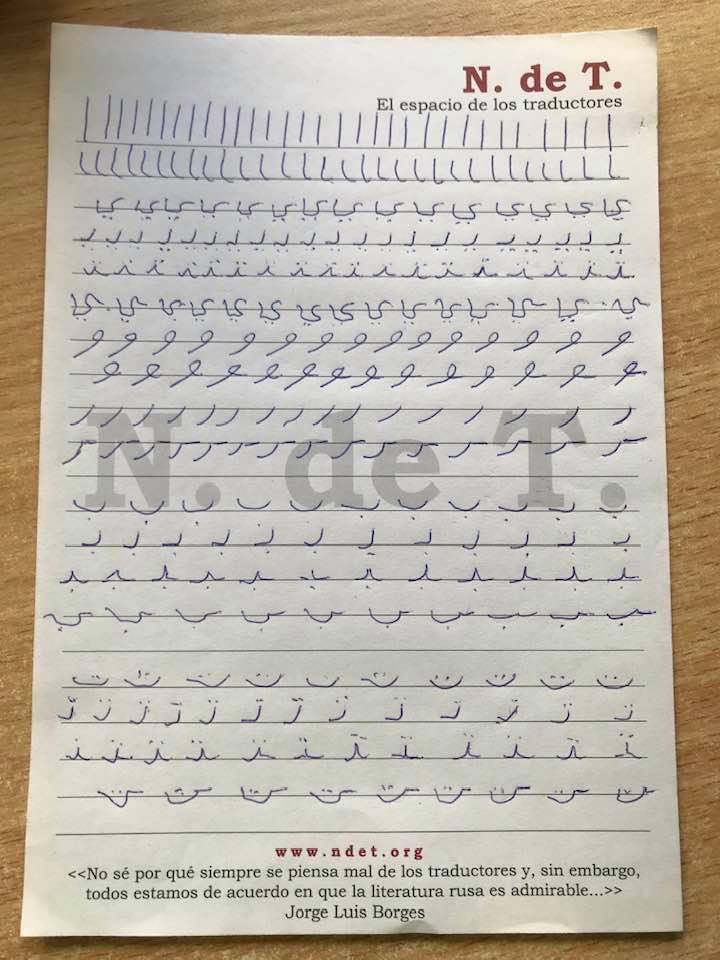
Mis palotes árabes

viernes, 19 de junio de 2020

Nuevos amigos: Erri de Luca


Hoy terminé el primer libro que leo de Erri de Luca. Gracias totales a mi colega Erika Cosenza por presentármelo.
Es... una delicia para el intelecto. Es exactamente el tipo de escritores que adoro: los que te regalan un camino bello. No me importa cómo terminan los cuentos. No me importa si terminan. Me interesa el mientras tanto, la maestría en el manejo de la lengua. De esto, Erri tiene de sobra.
Me encontré retrocediendo muchísimas veces para volver a paladear ciertos párrafos, algún adjetivo inesperado, algún sintagma fulminante (los soldados jóvenes como "adultos involuntarios").
Gracias, Italia, por regalarnos al Dante, a Baricco y a De Luca.
Aurora Humarán


domingo, 7 de junio de 2020

Ginebra, la mujer que se llevaba las cosas de la tumba de Borges y Estela Canto.


Pocos antepasados me generan tanto orgullo como Estela Canto. Es un honor tener algo de sus genes. Estela era una mujer del todo incorrecta (diríamos hoy) en varios sentidos. Atea. Comunista. Polémica siempre. Todo imperdonable en ciertos círculos en aquellos años. Fue una gran traductora. De hecho, En busca del tiempo perdido muestra en la tapa el nombre de Marcel Proust y el de Estela, la traductora. También escribía relindo. Y también le escribieron a ella. Mi amado Jorge Luis Borges le dedicó El Aleph. Dicen algunos que Estela fue el amor de su vida, su musa. 
Estela Canto y Jorge Luis Borges
Parecida a mi abuela Amelia Tabossi Urquiza, hija de María Elena Canto.
.


De viaje por las Uropas hace unos años, hice una escala de dos días en Ginebra exclusivamente para visitar a Georgie (como lo llamaba Estela). Apenas llegué al hotel, dejé mis valijas y me fui caminando rapidísimo al Cementerio de los Reyes (Plainpalais) para visitar a mi escritor favorito. Algo me hizo entrar por una puertita que estaba muy cerca de su tumba… que no tardé en encontrar. 


Filmé el momento en que me iba acercando en la tonta ilusión de estar cerca de El Maestro. Estuve horas en ese lugar que no llegaba a percibir como un cementerio. Mirando hacia atrás me extraña eso mismo y pensar cómo llené todas esas horas… Soy hiperkinética incurable motivo por el que odio las peluquerías y jugar al ajedrez (perdón, Maestro). Eso de estar sentada, quieta, callada no es para mí. Lo cierto es que estuve horas en estática devoción.  Saqué millones de fotos. Di de beber al pasto con unas regaderas que encontré cerca. Dibujé la tumba. Sabía bastante sobre ella, incluso sin haber leído el excelente libro de Martin Hadis (Siete guerreros nortumbrios. Enigmas y secretos en la lápida de Jorge Luis Borges, de Emecé).

En algún momento, me fui. Recuerdo haber visto otras tumbas de personajes famosos en ese verde verde tan verde cementerio con ese verde verde tan vivo que es quizás lo que explica la sensación que se tiene allí: vida que se impone a y paz.


Recuerdo que leí Jean Piaget, Juan Calvino, Alberto Ginastera y el nombre de la hija de Dostoyevsky.

Al día siguiente, luego de desayunar, regresé al cementerio. Yo creo que estuve sentada hablando mentalmente con Borges. No logro explicar qué hice durante horas en ese lugar, pero ¿de qué serviría saberlo o entenderlo?

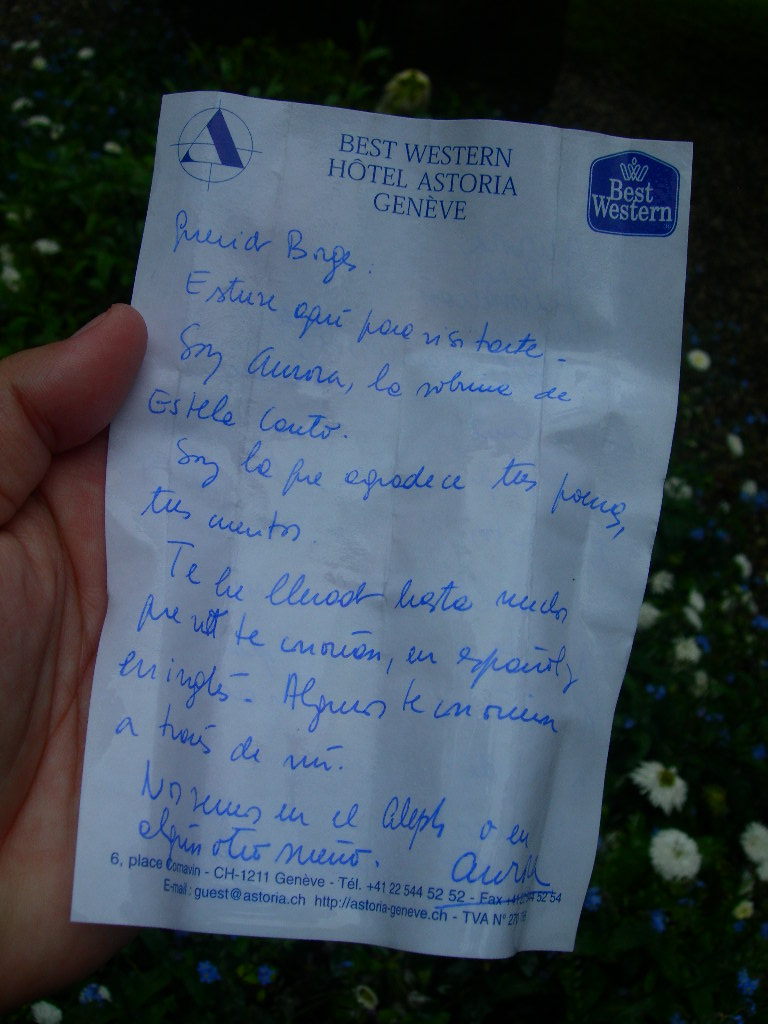
Cuando llegó el momento de la despedida, me empezó a doler un Borges en todo el cuerpo así que decidí dejar la trillada, baladí e inútil nota que nadie leería. La puse en un ganchito que vi entre el pasto. En ese momento, empezó a lloviznar. Qué rabia, pensé, se va a desteñir mi mensaje. Me fui cuando ya llovía tupido*.


Varios años más tarde, con ojos asombrados leo un artículo en el Diario Clarín sobre una mujer que vive en Ginebra y que cada día de su vida va a la tumba de Borges a llevarse las cosas que dejan, dejamos, sus admiradores. Ella menciona la hojita del Best Western Hotel Astoria que dejó Aurora, sobrina de Estela Canto… Ay…


Aurora Humarán

* palabra homenaje a mi padre.